

A declarative admin for Sillo. Declarations are values, not class attributes, and a type annotation never selects behaviour.
A warder keeps the keys. This one keeps your models — what is listed, what is editable, who may see it, and which rows are theirs.
pip install warder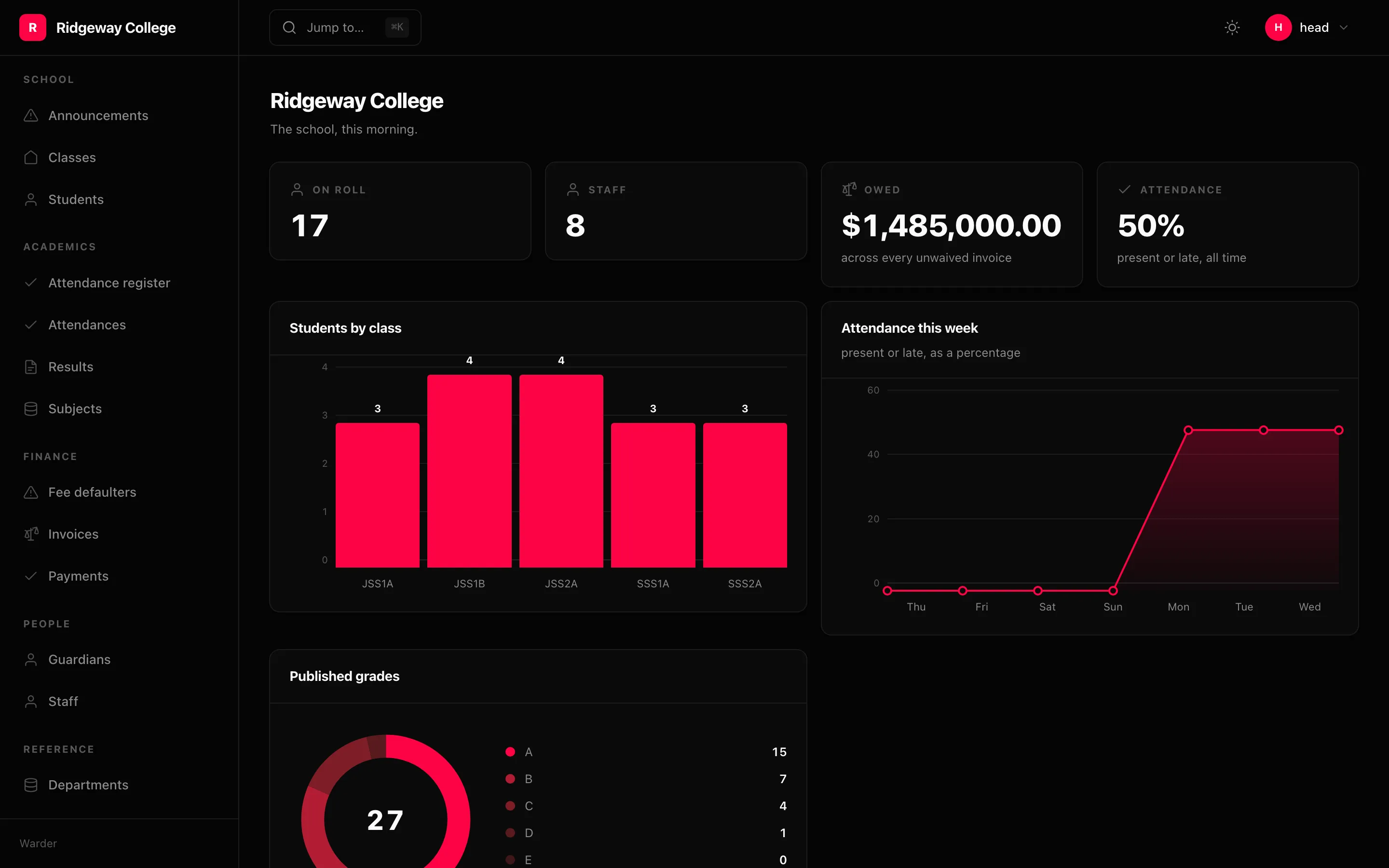
Unlike the other packages here, Warder imports under its own name rather
than under sillo.. It is not an extension of the framework’s surface; it is an
application you mount on yours:
from warder import Admin, Column, List, Resource
admin = Admin(title="Acme Ops", prefix="/admin")admin.add(Resource(Post, list=List(Column("title", link=True))))admin.mount(app)
That is a working admin. Resource(Post) on its own is also a working admin —
list, form and detail page are all derived from the model’s own columns at
mount, and every derived part is replaced by naming it.
Three ideas
Section titled “Three ideas”Each one is a decision you feel by the second screen you write.
A type annotation describes a type. It never selects behaviour.
Section titled “A type annotation describes a type. It never selects behaviour.”Nothing in Warder reads __annotations__, and nothing changes because a
parameter is spelled one way rather than another. Where something must be
injected it arrives as a value — a default, a keyword — because a value is
visible and an annotation is not.
The one place arity would ordinarily be sniffed is a rule callable, so it is
not: a rule is always called as (ctx, row), with row set to None when
the question is about the model rather than one row.
Access(change=lambda ctx, row: row.team_id == ctx.user.team_id)Gate.custom(lambda ctx: ctx.user.email.endswith("@acme.com")) # gates see no rowA declaration is a value
Section titled “A declaration is a value”Nameable, storable, comparable, generatable in a loop, extendable with
.with_(). No metaclass, no class attributes with meanings you cannot derive,
and no registration by import side effect.
def reference(model, *names):    return Resource(        model,        group="Reference",        list=List(*[Column(n) for n in names], sort=Sort.asc(names[0])),        form=Form(Section("", *[Field(n) for n in names])),    )
for model in (Tag, Category, Region, Currency):    admin.add(reference(model, "name", "slug"))
Mistakes fail at mount, not at request
Section titled “Mistakes fail at mount, not at request”Every reference is resolved once, at start-up, against the model — and the error carries the file and line the declaration was written on:
DeclarationError: Resource(Post).list column 'titel' is not a field of Post. Did you mean 'title'? Declared at app/admin.py:24Values are checked even earlier, from the constructor, where the mistake was typed:
Column("total", align="middle")# ValueError: align='middle' is not valid. Use one of: 'left', 'center', 'right'.What you get
Section titled “What you get”list sortable columns, URL-backed filters, selection, bulk actions, paging, column visibility, CSV and JSON export of the filtered setform a control per widget kind, conditional fields, per-field errors, a searching relation picker, a many-to-many editordetail panels: fields, and child tables drawn with the child resource's own columnsdashboard number, chart and table cardsshell grouped navigation, flash messages, a light/dark toggle, `/` to search and ⌘K to go anywhereThe interface is Inertia, React and Tailwind, and it is in the wheel.
pip install warder needs no Node, no build step and no network call.
Requirements
Section titled “Requirements”Python 3.10 to 3.14, and Sillo v1 — the context API, HttpContext and the
free builders in sillo.responses. Nothing else at runtime.
Every screenshot in this manual is of the example application in Quickstart, rendered by the same build that ships in the wheel.