

A column names a value and says how to draw it. There is one class; the
classmethods are shorthands that fill in a Format.
Column("title", link=True)Column.badge("status", colors={"live": "green", "draft": "zinc"})Column.relation("author", display="email")Column.many("tags")Column.compute("Words", lambda row: len(row.body.split()), sort="word_count")The shorthands
Section titled “The shorthands”Column(name) | plain, formatted from the column’s own type at mount |
Column.text(name, truncate=, mono=) | text, optionally clipped |
Column.code(name) | monospace in a tinted box |
Column.number(name, precision=, prefix=, suffix=) | grouped by thousands |
Column.money(name, "USD") | in the viewer’s locale |
Column.percent(name, of=) | of=100 when the column holds 0–100 |
Column.bytes(name, binary=) | 1.4 MiB or 1.5 MB |
Column.duration(name) | 2m 14s |
Column.date(name, "relative") | date, datetime, time, relative, iso |
Column.boolean(name, style=) | icon, text, dot |
Column.badge(name, colors=, labels=) | a coloured pill |
Column.tags(name) | small pills with the overflow collapsed |
Column.progress(name, max=) | a bar |
Column.image(name) / Column.avatar(name) | a picture, or a picture and a name |
Column.json(name) | collapsed JSON |
Column.relation(name, display=) | a foreign key, drawn as the far row |
Column.many(name) | a many-to-many, drawn as clickable chips |
Column.compute(label, fn, sort=) | a value derived in Python |
Column.url(label, to=) | a link built from the row |
boolean rather than bool, and the reason is worth knowing: a method named
bool shadows the type inside its own class body, so every later flag: bool
annotation resolves to the method. The method gave way.
Computed columns can be sorted
Section titled “Computed columns can be sorted”Column.compute("Read", lambda row: f"{row.words // 200} min", sort="words")sort= names the database column that stands in for the computed value. Without
one the header is not clickable — which is honest: there is nothing for the
database to order by. A computed column that cannot be sorted is a column people
stop using, so the escape hatch is part of the constructor rather than something
you discover you cannot do.
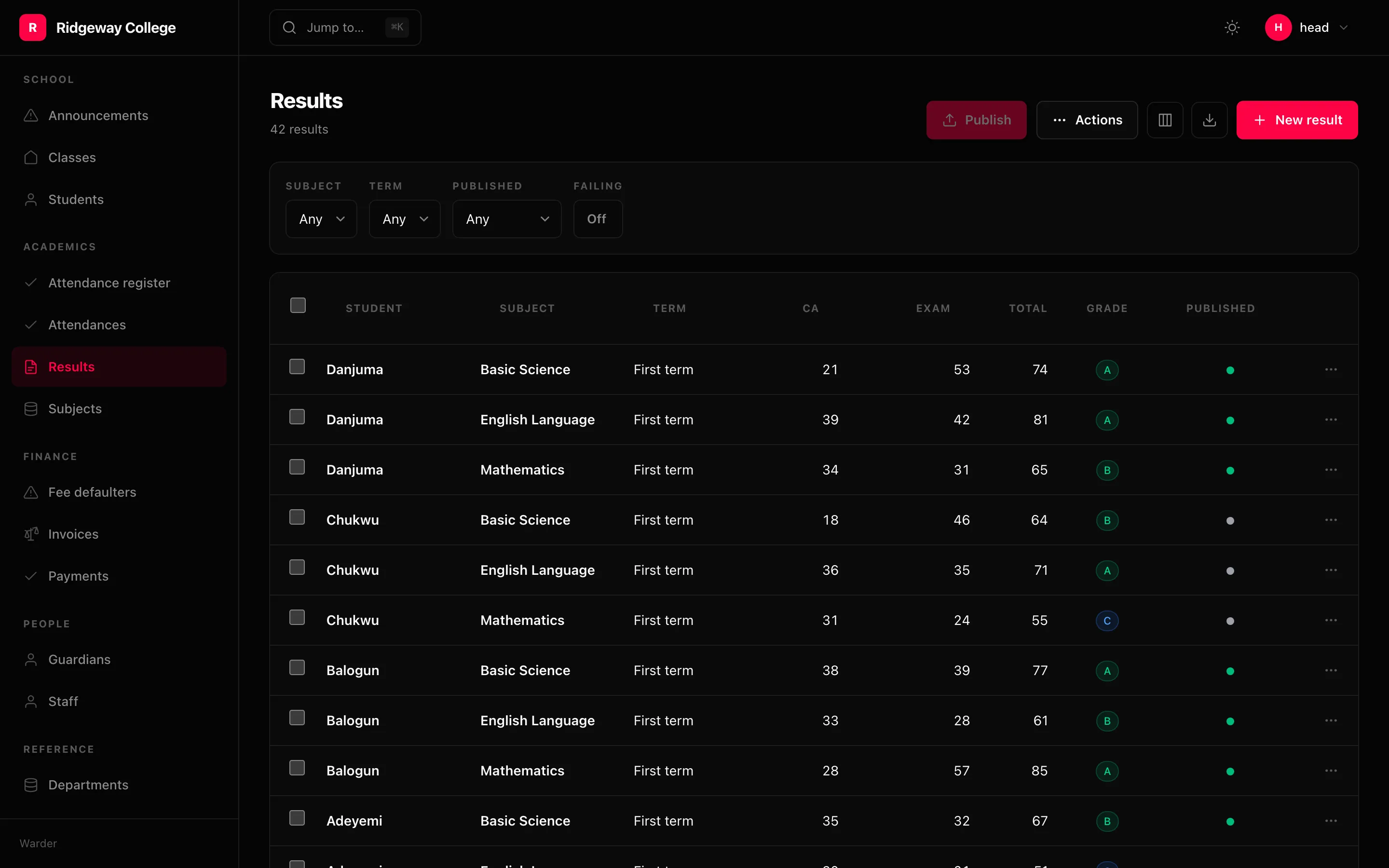
The Total and Grade columns above are computed in Python — one sums two
database columns, the other turns that into a letter and hands it to
Format.badge. Neither exists in the database, and only the first could be
sorted by naming a column that does.
Alignment comes from the format
Section titled “Alignment comes from the format”>>> Column.money("total").alignment'right'Numbers, money, percentages, bytes and durations align right and get tabular
numerals, because a number that is not right-aligned cannot be scanned down a
column. align= overrides it.
Format, on its own
Section titled “Format, on its own”Format is the read half of the display pair; Widget
is the write half. Keeping them apart is why a status can be a coloured badge in
a list and a select in a form without either declaration knowing about the other.
Column("status", format=Format.badge(colors={"live": "green"}))Column("size", format=Format.bytes(binary=False))Column("rate", format=Format.percent(precision=1))A format is a kind and its options, and nothing else — no rendering code, because it has to cross the wire:
>>> Format.money("EUR")Format('money', currency='EUR', precision=2)Access, per column
Section titled “Access, per column”Column.money("salary", access=Access(view="staff.salary.view"))A column you may not view is absent from the props, not hidden with CSS. It never reaches the browser, so no amount of devtools brings it back.
Width, wrapping and visibility
Section titled “Width, wrapping and visibility”Column("body", wrap=True, width=420) # prose gets room and wrapsColumn("id", width=80, sticky=True) # stays put when the table scrollsColumn("internal", toggle=False) # cannot be hidden by the viewerWhich columns a viewer hides is remembered per browser, because it is a preference of theirs about this screen rather than something to put in the URL.