

One control, one query parameter, one queryset transformation — and why the escape hatch is not a special case.
Every filter is the same thing wearing different clothes: a control in the toolbar, a value in the query string, and a transformation of the queryset. It declares its own control, parses its own value and applies its own narrowing.
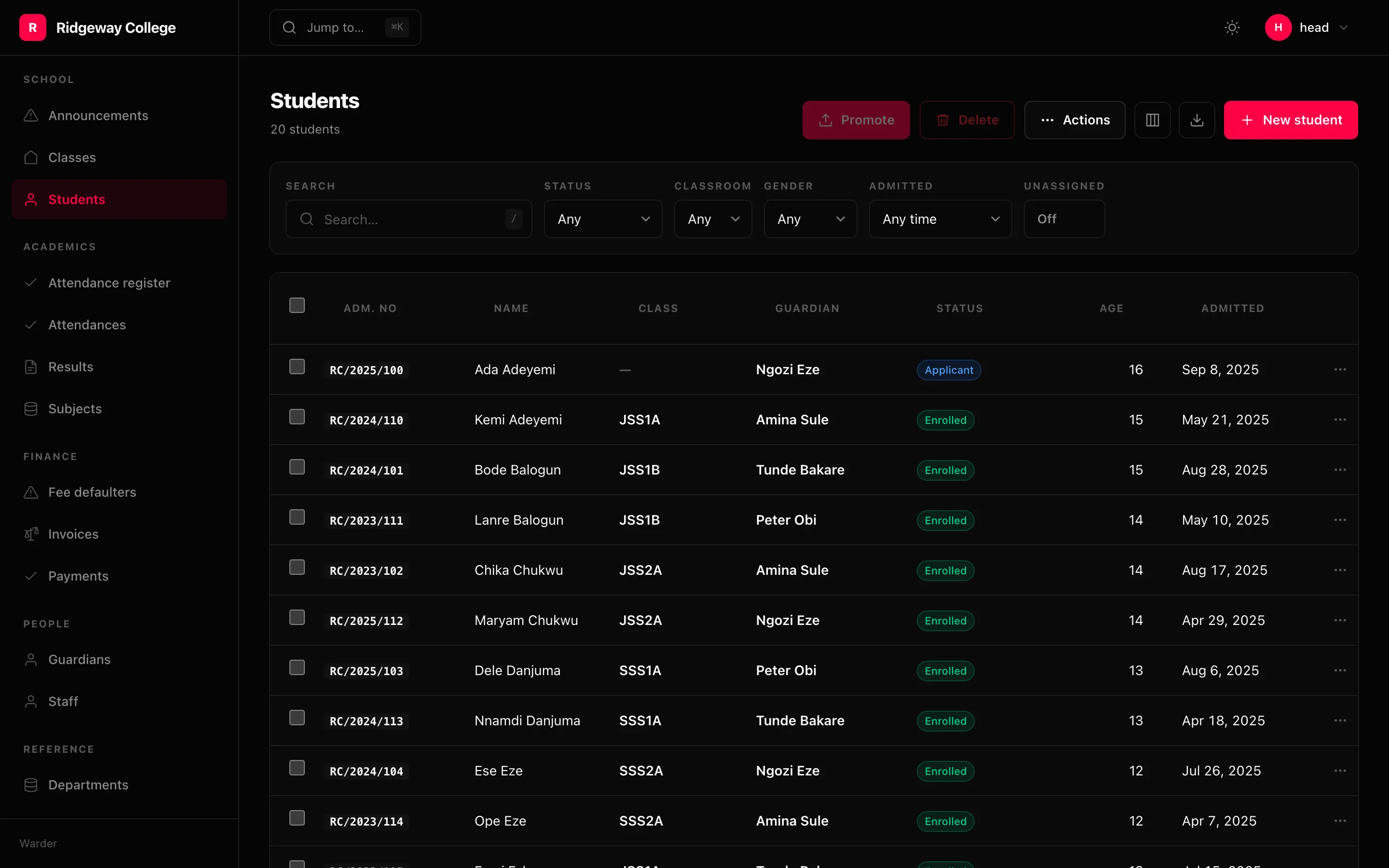
filters=[ Filter.search("first_name", "last_name", "admission_no"), Filter.choice("status", STUDENT_STATES), Filter.relation("classroom"), Filter.date_range("admitted", presets=["30d", "quarter", "ytd"]), Filter.toggle("Unassigned", lambda rows: rows.filter(classroom_id=None)),]The kinds
Section titled “The kinds”Filter.search(*fields) | one box across several columns, OR-ed. Keyed q |
Filter.text(name, lookup=) | one field. icontains by default |
Filter.choice(name, choices, multiple=) | a fixed set |
Filter.boolean(name, labels=) | yes / no / unset — three states, because “no filter” is one |
Filter.exists(name) | whether a nullable column has a value |
Filter.date_range(name, presets=) | two dates, with named shortcuts |
Filter.number_range(name) | 10..50, either end open |
Filter.relation(name, display=) | a picker over the related table |
Filter.toggle(label, narrow) | a chip that is on or off; narrow(rows) |
Filter.custom(label, narrow) | anything else; narrow(rows, value) |
The escape hatch is not a second code path
Section titled “The escape hatch is not a second code path”Filter.custom and Filter.toggle have the same three parts as every built-in
kind — a control, a query parameter, a queryset transformation — so they go
through the same pipeline. There is no “custom filters work differently” caveat
because there is no second implementation.
Filter.toggle("Long reads", lambda rows: rows.filter(words__gte=800))Filter.custom("Region", lambda rows, value: rows.filter(region=value))Filter.custom("Tier", lambda rows, value: rows.filter(tier=value), choices=["free", "pro", "scale"]) # renders as a selectDate presets
Section titled “Date presets”today, yesterday, 7d, 30d, 90d, month, last_month, quarter,
ytd, 12m, all. A preset a filter does not offer is refused at declaration
time, not at request time.
>>> Filter.date_range("admitted", presets=["fortnight"])ValueError: preset='fortnight' is not valid. Use one of: 'today', 'yesterday', …Explicit ranges work too: ?admitted=2026-01-01..2026-02-01.
Unset means off
Section titled “Unset means off”>>> Filter.text("title").parse("")NoneNone means “this filter is doing nothing” and is never a value. A filter that
needs to match NULL is Filter.exists instead, so there is one answer to “is
this filter on”.
Searching, and only re-fetching the rows
Section titled “Searching, and only re-fetching the rows”The search box debounces and asks for a partial reload of rows, total,
pages and query — so the navigation, the other filters and the scroll
position stay exactly where they were. Everything else applies on change,
because a select that waits for you to press a button is a select you press
twice.