

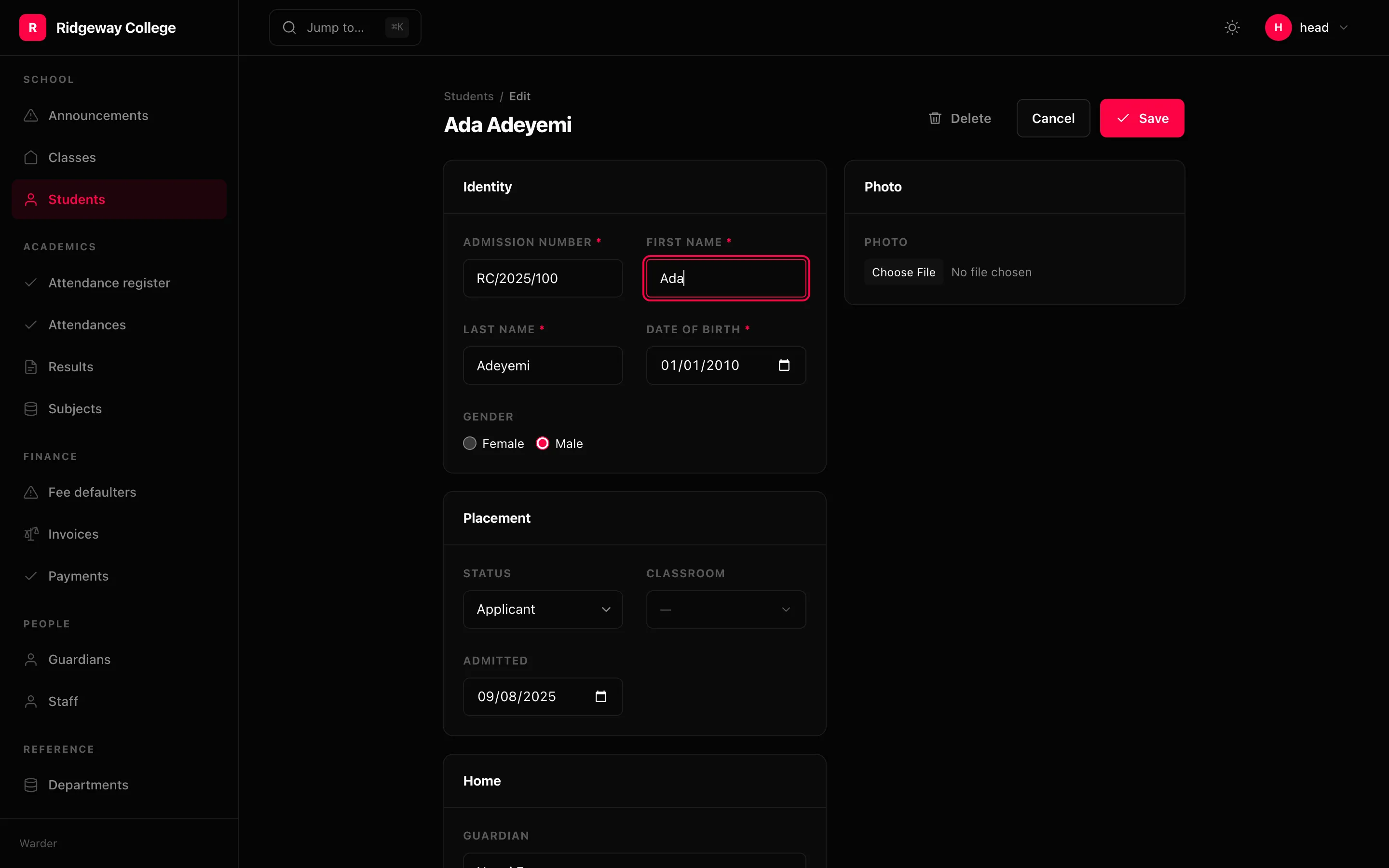
Form( Section( "Identity", Field("admission_no", label="Admission number"), Field("first_name", autofocus=True), Field("last_name"), Field("date_of_birth"), Field.radio("gender", ["female", "male"], inline=True), columns=2, ), Section( "Placement", Field.select("status", STUDENT_STATES), Field.relation("classroom", display="name"), Field("admitted"), columns=2, ), sidebar=[Section("Photo", Field.image("photo"))], layout="split",)Most fields say nothing but their name
Section titled “Most fields say nothing but their name”The widget, whether the input is required, its maximum length and its choices are all read from the database column at mount — from the schema, which states them, rather than from an annotation, which describes a type.
Field("published_at") # → a datetime pickerField("status") # → a select, from the column's choicesField("body") # → a textarea, because the column is long textThis holds for a form you wrote as well as one that was derived. Otherwise
Field("published_at") inside a Section would be a text box while the same
field on a derived form got a date picker — the same declaration behaving
differently depending on how much of the screen you spelled out.
Name a widget when the default is wrong about the meaning rather than the
type: body and internal_note are both long text, and only one of them wants
Markdown.
Field.markdown("body", height=360)Sections
Section titled “Sections”A form of twenty inputs in one column is a form nobody finishes. An empty title makes an unlabelled group — the right shape for the two or three fields at the top that need no heading over them.
Form( Section("", Field("name"), Field("slug")), Section("Audit", Field.readonly("created_at"), collapsed=True),)Bare fields work too, and runs of them group where they were written rather than being hoisted to the top:
Form(Field("a"), Section("More", Field("b")), Field("c"))# → three groups, in that orderA collapsed section holding a field that failed validation is opened anyway: an error you cannot see is an error you cannot fix.
Conditions
Section titled “Conditions”Field("published_at", show=When("status", equals="live"))Field("trial_ends", show=When("plan", none_of=["free"]))Field("vat", show=When.all(When("country", equals="GB"), When("business", is_true=True)))A When is a condition as data. It is serialised into props and the renderer
evaluates it against the form’s current values, so the field appears the instant
status becomes live — no round trip, no flicker.
The server evaluates the same condition before it writes. A field the condition says is not on the form cannot be saved by somebody who edits the request.
Tests: equals, not_equals, any_of, none_of, is_true, is_false,
filled, empty, combined with When.all, When.any and ~.
Readonly, hidden and unviewable
Section titled “Readonly, hidden and unviewable”Three different things:
Field.readonly("created_at") # shown, never writtenField("token", hidden=True) # sent, not drawn — not a secretField("salary", access=Access(view="hr.view")) # never leaves the processA readonly field is readonly on the server: rendered disabled and dropped from the write. The two have to agree, or the first is decoration.
Validation
Section titled “Validation”A check returns a message to complain and None to pass, so writing one takes
no imports. All of them run, so a form reports everything wrong at once rather
than one thing per submission.
Field("email", validate=[ lambda v: "Required" if not v else None, lambda v: "Needs an @" if v and "@" not in v else None,])Whole-form checks run only once every field has passed its own, and are given the context and the row:
def together(ctx, values, row):    if values["ends"] < values["starts"]:        return {"ends": "The end cannot be before the start."}
Form(..., validate=together)
A database constraint the form could not know about — a unique index, a NOT NULL on a column nobody put on the form — comes back as the form with an explanation, not a 500 and an empty form.
Layout
Section titled “Layout”Form(..., layout="split", sidebar=[Section("Media", Field.image("hero"))])Form(..., width="narrow") # narrow, normal, wide, fullSection(..., columns=2)Field("body", span=2)