

They really are different questions, and one answer does not cover the others.
| Question | Answered by |
|---|---|
| May you get in at all? | Gate |
| May you do this to this model? | Access |
| May you do it to this row? | Access callable, and Scope |
| May you see this field? | Access on a Column or Field |
None of it is a second authorisation system: it compiles onto
sillo.permissions, which already ships Permission, Group,
UserPermission and PermissionMixin.
Gate — may you get in
Section titled “Gate — may you get in”Gate.staff() # the defaultGate.superuser()Gate.permission("admin.access")Gate.role("support")Gate.any(Gate.role("owner"), Gate.permission("admin.access"))Gate.custom(lambda ctx: ctx.user.email.endswith("@acme.com"))Gate.staff() matters more than it looks. When the admin shares the
application’s user model — the ordinary arrangement — every registered account
holds a session, and admitting anyone with one hands over the database.
Gates compose with |, & and ~.
Access — may you do this
Section titled “Access — may you do this”Access(view=True, add="post.add", change="post.change", delete=False)Each of the four takes True, False, a permission name, or a callable invoked
as (ctx, row) — with row set to None when the question is about the
model rather than one row.
There is no arity sniffing. A rule is always (ctx, row), because inspecting how
many parameters you wrote is exactly the kind of invisible behaviour this package
exists to avoid.
Access(change=lambda ctx, row: row.author_id == ctx.user.id)Registering a Resource declares four permissions — <stem>.view|add|change| delete — so what a deployment can grant is derived from what is registered
rather than typed twice.
Scope — which rows exist
Section titled “Scope — which rows exist”Scope.tenant("team_id")Scope.owner("author_id")Scope.by(lambda ctx: {"team_id": ctx.user.team_id})Scope.query(lambda ctx, rows: rows.filter(region__in=ctx.user.regions))A scope narrows the queryset before anything else touches it — the list, the detail lookup, the form’s save, and every action. Something outside your scope is not “hidden”; as far as your session is concerned it is not there, which is the only version of this that does not leak through a count.
A row outside your scope is a 404, not a 403. Telling somebody a row exists that they may not see is itself a disclosure.
Both are needed
Section titled “Both are needed”Resource( Order, access=Access(change=lambda ctx, row: row.team_id == ctx.user.team_id), scope=Scope.tenant("team_id"),)Access decides whether a button is shown and whether a write is allowed; Scope
decides what is in the list at all. Access without scope leaks the existence of
rows through pagination counts and search results; scope without access leaves a
writable object reachable by its id.
Use current_user, not ctx.user
Section titled “Use current_user, not ctx.user”Inside a rule of your own, read the account with current_user(ctx). The context
raises when no authentication middleware is installed, and
getattr(ctx, "user", None) does not help — the default only catches
AttributeError, and what comes out is a ValueError.
from warder import Scope, current_user
async def my_students(ctx, rows):    identity = getattr(current_user(ctx), "id", None)    staff = await Staff.filter(user_id=identity).first() if identity else None    if staff is None:        # Signed in, but not staff. Nothing rather than everything: the        # failure mode of a scope should be to show less.        return rows.filter(pk__in=[])    return rows.filter(classroom__form_teacher_id=staff.id)
Resource(Student, scope=Scope.query(my_students))
Fields
Section titled “Fields”Field("salary", access=Access(view="hr.salary.view", change="hr.salary.change"))Column("email", access=Access(view="pii.read"))A field you may not view is absent from the props, not hidden with CSS — so it never reaches the browser. One you may view but not change renders readonly, and a write to it is rejected server-side rather than trusted.
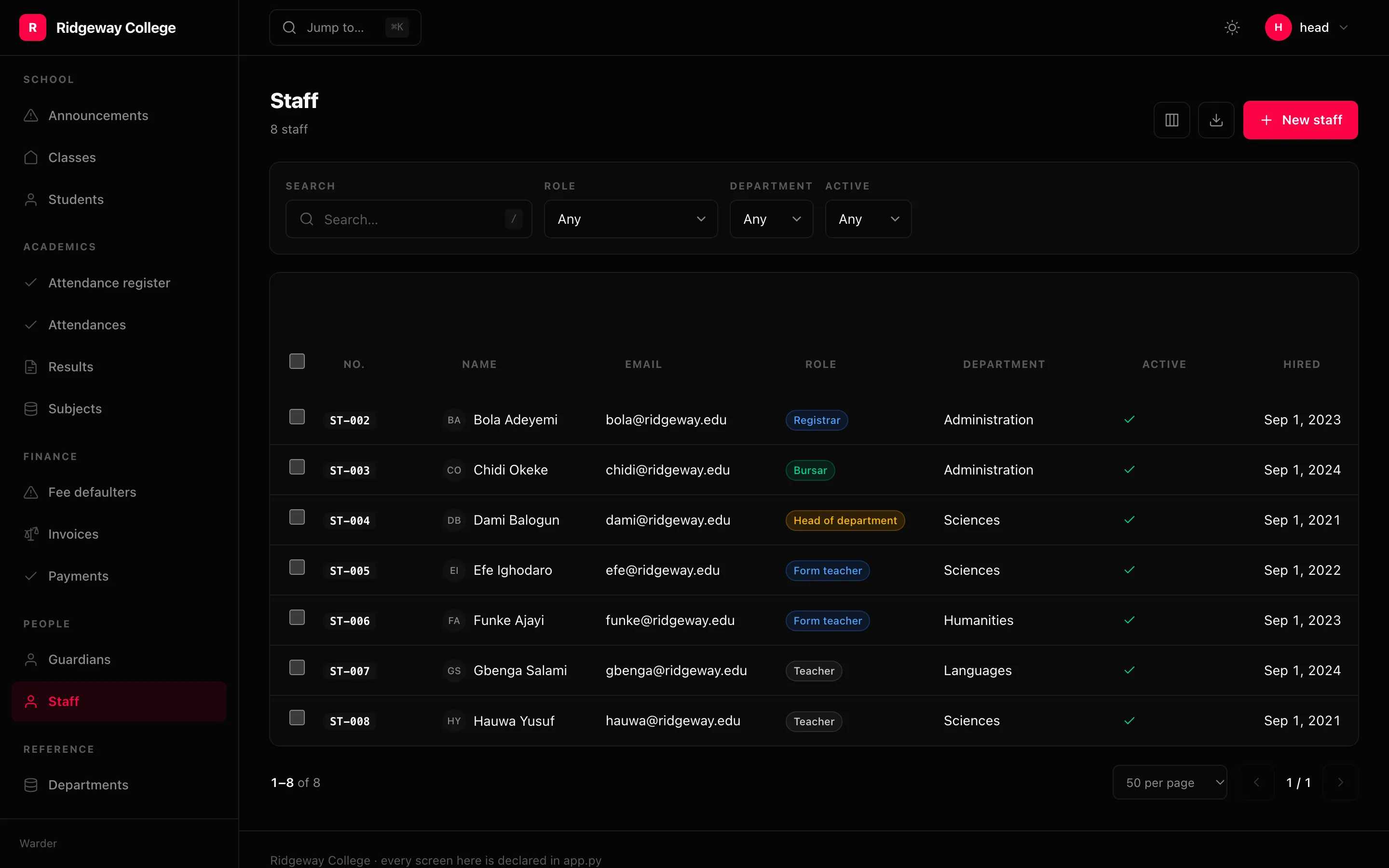
The salary column above carries Access(view="staff.salary.view"). Somebody
without it does not see a blank cell; the column is not in the table, and the
number was never sent.
admin.roles( Role("teacher", grants=["student.view", "result.view", "result.add"]), Role("form_teacher", inherits=["teacher"], grants=["student.change"]), Role("bursar", grants=["invoice.view", "invoice.add", "payment.view"]), Role("principal", grants="*"),)A Role compiles to a Group with its GroupPermission rows, so after the
first sync roles are data — editable in the admin itself, by somebody who is
not going to edit Python.
Every grant is checked at mount against the permissions the registered resources declare, so a typo is a start-up failure rather than a permission nobody notices is missing:
Role 'registrar' grants 'class.add', which no registered resource declares. Did you mean 'class-room.add'? Declared at app/admin.py:264Role.crud(Post, Tag) writes out the eight standard names using the same stem a
Resource derives, so a role written that way stays correct as resources change.
The interface is not the control
Section titled “The interface is not the control”Every check above holds against a request that skips the browser entirely. The buttons a person cannot use are hidden, the columns they cannot see are absent, and both are courtesies on top of a server that would refuse anyway.