

Foreign keys and many-to-many — clickable references, a searching picker, and the joins that come from declaring them.
A relation is a reference, and a reference is something you click
Section titled “A relation is a reference, and a reference is something you click”Column.relation("author", display="name", link=True)The author on a post is a link to that author. The href is computed on the server, because only the server knows what is registered — a relation to an unregistered model gets a label and no link, rather than a link to a 404.
{"id": 1, "label": "Ada Lovelace", "href": "/admin/author/1"}This holds everywhere a relation appears: in a list, on a detail page, and inside a child panel.
Declaring it is what removes the N+1
Section titled “Declaring it is what removes the N+1”Column.relation("author") — and any "author__email" traversal — contributes
to List.joins, which becomes select_related. A plain Column("author") is
dressed into the same thing at mount, because the two should not behave
differently when the model says the same thing about both.
Many-to-many
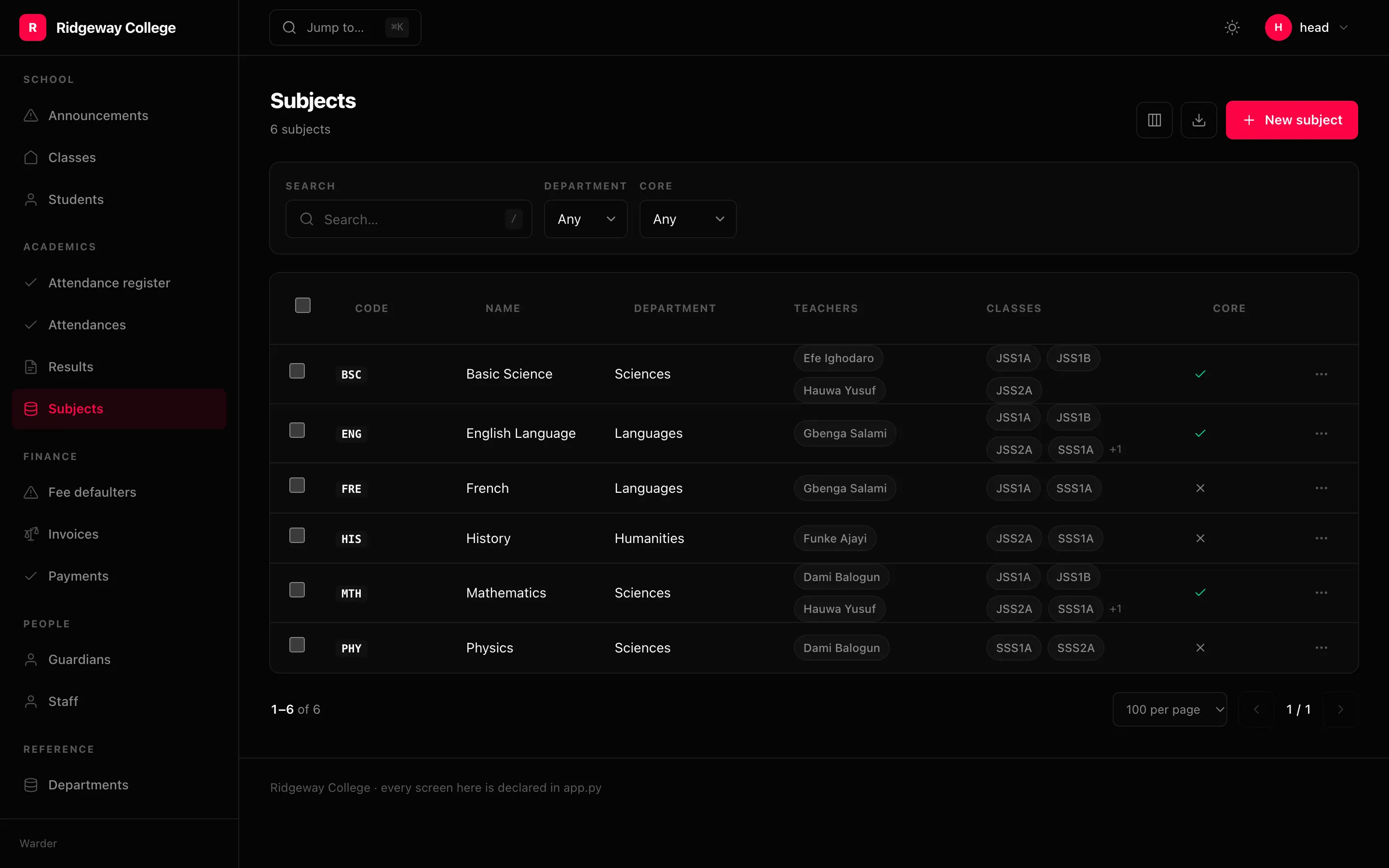
Section titled “Many-to-many”Column.many("teachers", display="name")Drawn as clickable chips, with the overflow collapsed to +4. It is
prefetched, never joined — one subject with four teachers is four rows if you
join it — so it costs one extra query for the page rather than one per row.
>>> List(Column.many("tags")).prefetches('tags',)>>> List(Column.many("tags")).joins()The picker
Section titled “The picker”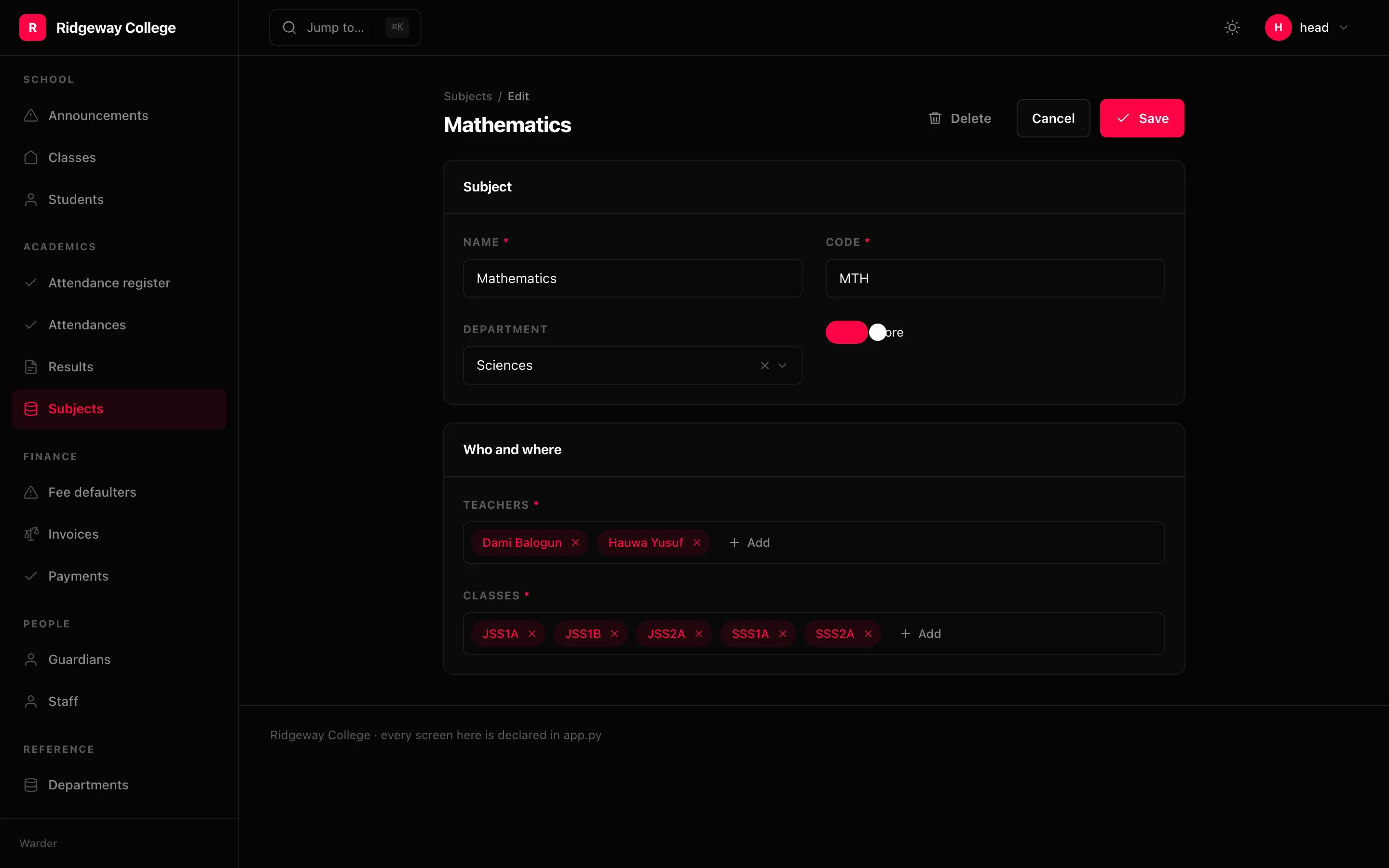
Field.relation("classroom", display="name")Field("tags", widget=Widget.relation(display="name", multiple=True))It searches over the wire against {resource}/options/{field}, twenty-five rows
at a time, rather than loading every row into a <select>. With multiple it is
the many-to-many editor: chips for what is chosen, a search for what is not.
Labels for values that are already chosen are resolved through ?ids=, or an
edit form opens showing raw numbers for everything already selected.
Saving a set
Section titled “Saving a set”The form sends the whole set, so the server clears and re-adds rather than diffing — a diff would be guessing at an intent the browser already stated. Both calls are one statement each, whatever the size of the set. Many-to-many is written after the row exists, because a join table needs both sides.
Child tables
Section titled “Child tables”Detail( Panel.related("Students", Student, limit=40, sort=Sort.asc("last_name")), Panel.related("Subjects", Subject, limit=20), # a many-to-many)Panel.related follows a foreign key or a many-to-many: a class’s subjects
is as much “the rows belonging to this one” as a post’s comments are. Two ways
back is refused at mount rather than guessed:
Resource(Author).detail panel 'Comments' could reach Author through 2 relationson Comment: author, reviewer. Pass via= to say which one. Declared at app/admin.py:88Picking the first of author and reviewer would be wrong half the time and
silent both halves.
The display field
Section titled “The display field”display= names the attribute on the far side to show. Left out, the resolver
picks one: a conventional name first (name, title, label, email,
username, slug, code, reference, number), then the first unique text
column, then the first text column at all — falling back to the model’s own
__str__.