

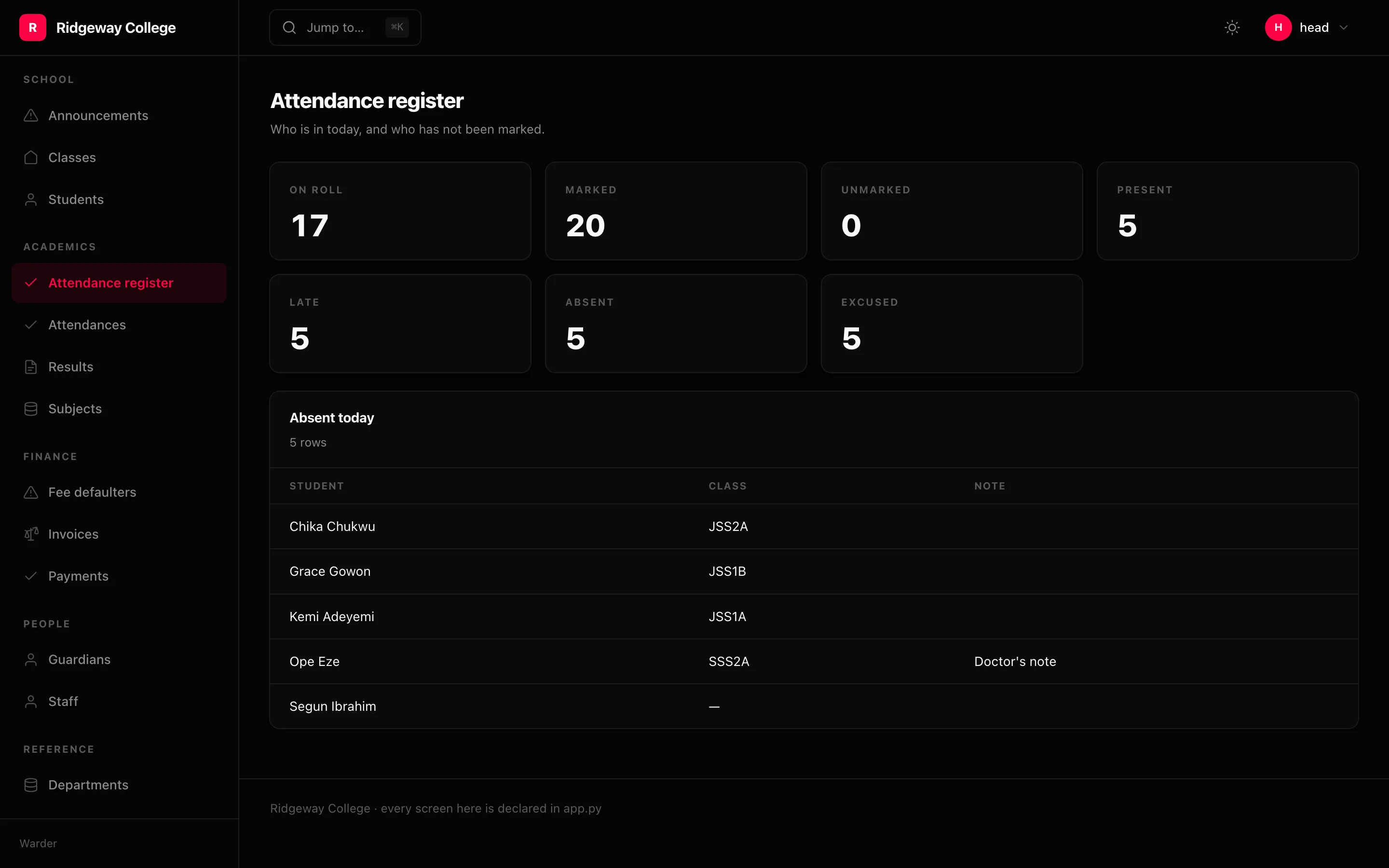
Every admin grows screens that are not a table of one model: a reconciliation tool, a queue you work through, a page of numbers somebody opens every Monday.
async def register(ctx):    today = date.today()    return {        "on_roll": await Student.filter(status="enrolled").count(),        "marked": await Attendance.filter(on=today).count(),        "absent_today": [            {"Student": str(a.student), "Note": a.note or ""}            for a in await Attendance.filter(on=today, status="absent").limit(25)        ],    }

admin.add(    Page("/register", "Attendance register", register,         icon="check", group="Academics",         description="Who is in today, and who has not been marked."))
That is gated, grouped and navigated the same way a resource is — because the alternative is a route somewhere else in the application with its own idea of who may see it.
What a handler returns
Section titled “What a handler returns”A mapping, and the page renders it generically: numbers become statistics, lists of records become tables, everything else becomes a definition list. It is not a placeholder — it is a useful screen you did not have to build.
Return an Outcome instead to redirect or download:
Page("/export", "Nightly export", lambda ctx: go("/files/nightly.csv"))Your own component
Section titled “Your own component”Page("/reconcile", "Reconciliation", reconcile, component="acme/Reconcile")The props are whatever the handler returned. The component comes from your own build — see Embedding.
Page("/defaulters", "Fee defaulters", defaulters, gate=Gate.any(Gate.superuser(), Gate.permission("invoice.view")))Checked on the server. The navigation hides the link too, which is a courtesy and not a control.
Ordering and grouping
Section titled “Ordering and grouping”Page("/register", "Attendance register", register, group="Academics", weight=-1)Page("/internal", "Internal", handler, hidden=True) # routed, not in the navAdmin(groups=[...]) fixes the order of the groups themselves; anything not
named follows alphabetically.